Cultural burning by local tribal members and friends returned to Southern Humboldt Community Park on October 29. Brush piles that they made earlier from forest thinning were ceremoniously ignited, returning healthy fire (“n’shong konk” in Wailaki) to land that had not seen it in 150 years.
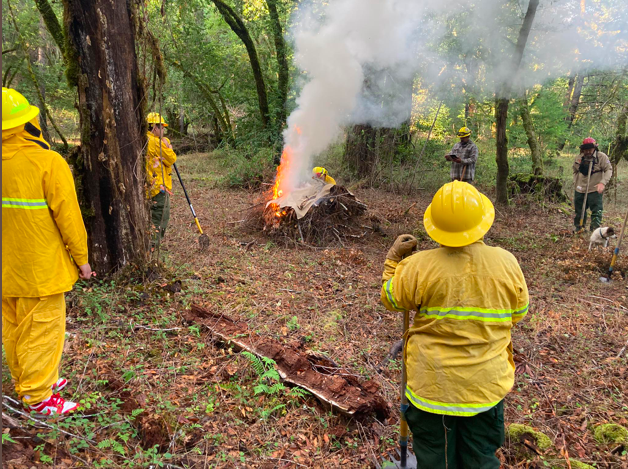
Photo from post by Native Health In Native Hands and Humboldt County Prescribed Burn Association
Returning fire to the ground is the final stage in reversing over a century of fire suppression. Along with manual thinning, pile burning is a safe way to catch up with the excess fuel that has resulted from fire suppression. It culminates in broadcast burning, once the fuel loads have been sufficiently diminished.
Cultural fire is the tribal analogue to prescribed burning. Both practices reduce fuel and promote forest health, but cultural burning extends to a broad range of practical and spiritual objectives.
Tribes tend the land with fire. They are using fire to restore the land from the accumulated fuel at the park, but that is only the initial step. Fire is also needed for the resources on which tribes depend. “A cultural burn is for resources—basket materials, medicine, food,” says Elizabeth Azzuz, secretary for the Cultural Fire Management Council.
Making biochar could theoretically be substituted for pile burning in connection with either cultural or prescribed burning. But although making biochar readily substitutes for pile burning, it does not have the same role in cultural burning that it has with prescribed burning, and it would not necessarily be welcome.
As we know, biochar makes a powerful soil amendment that lasts for hundreds of years or more, sequestering carbon that would otherwise return to the atmosphere. But the products of pile burning—smoke and ash, and a little biochar—are natural parts of fire. Cultural burning honors nature by allowing fire to proceed to ash, the way that it does naturally. Making biochar is an industrial process that isolates a natural process, benefiting nature by interrupting natural activity.
Biochar exists in nature. Making more of it than nature does is useful for increasing soil’s natural productivity and restoring it from various abuses such as compaction, depletion and contamination. But while productivity and restoration are not inherently against nature, they don’t necessarily entail a deep respect for it, which is the main point of cultural fire.
When biochar is made from sustainably harvested materials, it’s arguably in league with other methods of reducing fuel to restore healthy fire. It fits well as a precursor to prescribed burning. But as an adjunct to cultural fire, it has no precedent.
Many tribal members are trained in firefighting. They have joined Western fire practitioners to meet the shared threat of excess fuel that Westerners created. They understand that it will take all the tools—and everyone—to fix this problem. As we reach back across the aisle ourselves, IMO it’s incumbent upon us to respect the indigenous traditions that inform tribal practice by holding biochar as simply a contribution. While it clearly has a place, IMO we have much more to learn from them than they do from us.
When the first of these cultural burns took place at Southern Humboldt Community Park Oct. 19, 2023, only a few local firefighters were invited—nobody from the public. I asked Damien Roomets at Trees Foundation why the Institute for Sustainable Forestry, which had begun to team with Wailaki members on restoration projects at the park, was not informed about the event. He replied that it was intentionally unpublicized to avoid making a spectacle of Native Americans for white people.
Black Ripple stands for putting black on the ground, meaning both biochar and the footprint of healthy fire. As our stewardship activity brings us into contact with tribes whose relationship to the land is fundamental to their way of life, our internalized cultural disconnection from that relationship is bound to produce instances of what Will Harling called “stepping in the spinach.” Our best practice in this endeavor IMO is humility.