Biochar demonstration at Arcata Seed & Scion Exchange 2024
Read moreWorkforce Training in Forest Health
making biochar as an approach to managing biomass
During the pole construction workshop in Whitethorn last September, it was hard to miss the enormous pile of debris across the driveway. We were erecting a shade structure at the native plant nursery at the Lost Coast Education Center in back of the Whitethorn BLM field office over the weekend. I knew that BLM stations in other states were making biochar, but not here. What a great opportunity for an exhibition!
The following Monday, I contacted BLM King Range National Conservation Area about making biochar from the pile. Kacie Hallahan put me in touch with Bryan Boatman, Fire Management Officer for BLM in Arcata, who liked the idea. He had been prepared to incinerate the pile, but he was curious about biochar.
I had just learned that the California Conservation Corps now owns one of Kelpie Wilson’s Ring of Fire kilns. Brian Starks at CCC Fortuna said yes to bringing a new crew and the kiln to train them in making biochar. I put “the other Brian” in touch with Bryan Boatman, and the three of us chose Monday, Feb. 24 as the date. Bryan got someone to cover the pile with a tarp, but after it blew off in the big December storm, the pile never really dried out. I made sure we had propane torches on hand to light the kiln.

Bryan covered the pile as best he could.
The night before the presentation, the weather forecast was for rain and wind, so Bryan and I chose to switch it to Tuesday Feb. 25. The prediction for Tuesday was great.
This had no effect on Brian Starks and his CCC crew, who had committed to working Monday through Wednesday. The backhoe operator, Wayne from BLM, dismantled the pile for them and spread it out. Bryan Boatman and I were there to help. But even with two propane torches, it took over 1-1/2 hours to get this wet brush to light.

We worked all day in the rain, and it took three days for my boots to dry out!
At the end of the day on Monday, the CCC crew staged brush a for Tuesday’s burn and left a nice ring of biochar. The green grass and unburned leaves under the biochar impressed BLM engine operator Angus, who had seen many burn scars from pile burning. This is one of the chief benefits of switching from incineration to making biochar.

Small results from wet brush, but no soil damage from the burn. Dismantled Ring of Fire and covered pile for conservation burn in background.
Tuesday dawned warm and foggy, then became bright and sunny. The C’s got right to work scooping up the biochar, then setting up and loading the kiln again, with help from Wayne and his backhoe.

Wayne sifts through eight years of debris. Painted wood, PT and plywood are set aside to exclude contaminants from the char.
At about 10:15, we had about a dozen guests who came for the presentation. I addressed the group for 45 minutes or so and answered questions.

Talkin’ char with the assembled guests. If the tumbler on the tailgate is yours, contact me!
By the end of Wednesday, the brush pile was consumed, and LCEC ended up with a couple of cubic yards of biochar. How much carbon was displaced from the atmosphere? Check out my earlier post, How Much Carbon Does Biochar Sequester?

Photo credit: Nursery Manager Cheryl Lisin of Lost Coast Education Center. What nursery manager would not be proud to have this pile of char?
California Recognizes Cultural Burning

Last month, the State of California officially recognized the right of first peoples in the state to practice burning the way their ancestors did. Senate Bill 310, which passed the state assembly and state senate in September, has been entered into law and is in effect as of February 27.
The new law restores tribal sovereignty to the 109 federally recognized tribes in California for the use of Traditional Ecological Knowledge of fire in their ancestral territories, allowing them to burn without state permits, and places tribes on equal footing with the California Natural Resources Agency and local air resources control boards. Tribes can also access the Prescribed Fire and Cultural Burning Claims fund without having to complete formal burn plans.
Tribes use fire to enhance food sources, fiber resources, and medicinal plants as part of their belief system, while also establishing and maintaining wildfire resilience. This layered practice distinguishes cultural burning from prescribed burning, which simply reduces the severity of landscape fire. Together they are referred to as healthy fire.
Healthy fire and making biochar both reduce fuel in overstocked forests that has resulted from over 100 years of fire suppression. They can be seen as bookends, approaching the wildfire problem from opposite directions. Where manual fuel reduction is unnecessary, fire can be returned to a unit of forest land in a single step. Otherwise, manual treatment comes first, and the thinned material can be pyrolyzed and left in place as biochar, a valuable soil amendment for long-term forest health. In either case, the endpoint is to manage land with fire. Making biochar can be seen as transitional toward that end, although some biochar will continue to be made by us indefinitely for the many beneficial uses to which it can be applied.
We can be grateful that TEK still exists in California and that tribes are willing to work with us after all the damage that our culture caused to the forest and the people who sustained it before we arrived.
A press release from CNRA is available here.
How Much Carbon Does Biochar Sequester?
Find out how much carbon you’re drawing down by making biochar
Read moreThe Products of Pyrolysis
A guide to the solids, liquids and gases that can be made from biomass
Read moreNo Burn Scars From Char

Three months after a kiln burn at my place
If you burned the char, you'd burn the soil. But that's exactly what you're preventing.
Read moreAir Curtain Burners Now Exempt!
EPA has just exempted air curtain burners that make biochar
Read morePhotos from Pole Building Workshop

Natural builder Colin Gillespie of Laytonville teaching pole harvest and construction using local materials
Read moreBiochar Demo at 2024 Arcata Seed & Scion Exchange

Gray Shaw prepares the group for what they are about to experience
Representing the Institute for Sustainable Forestry with educational demonstration of biochar-making
Read moreAll-Day Biochar Workshop CANCELLED

Full day of instruction and learning by burning, turning excess forest material into a powerful soil amendment
Read moreNotes Following a Biochar Talk
Follow-up notes for a talk given to a local group, explaining biochar and why I make it
Read moreCruising for Poles
All-day workshop about selecting fir trunks in the forest for pole construction, 2/24/24
Read moreBiochar is Charcoal
Resolving the semantics about pyrolyzed biomass
Read moreThe Soil's the Limit on Adding Biochar
How much biochar should you add to your soil? The answer hinges on an understanding of biochar.
Sand, clay and silt consist of minerals. They provide a substrate for the formation of organic complexes, which bind the soil particles. Very slow weathering and dissolution by microbes can bring minerals into circulation in the soil food web. Biochar is not a mineral, but it behaves the same way. Like minerals, it is inert in the soil. However, it has a vastly greater surface-to-volume ratio. This is what supercharges soil life and productivity.
Biochar does not directly enhance soil productivity. Its tremendous contribution to soil ecology is indirect, through increasing the surface area required by the organic complexes that constitute soil life.
Our recent trials indicate that biochars that are engineered to build soil carbon and placed in the rhizosphere and … applied every year … can build an extra 1 tonne of carbon in 1-2 years. Suggest you read Han Weng's work on this which we summarised in Joseph et al. (2021), How biochar works, and when it doesn't: A review of mechanisms controlling soil and plant responses to biochar.
– Stephen Joseph PhD, Renewable Energy and Biochar Researcher and Consultant, UNSW
Any char is good. Some are better. Cooking at above 450°C provides permanence. Below that more SOC (food) but less biochar (structure).
– Albert Bates, coauthor of Burn and Terra Preta
Low temperature biochars can have a long lifetime if they form an organomineral coating on their surface and are taken into the soil microaggregate structure. This often occurs quickly in many tropical and sub tropical soils that have a high clay content.
– Stephen Joseph
How much is enough? The limit depends on whether labile organic matter (food) and water are in good supply. You will read that diminishing returns and possibly even lower yields start above 10% biochar by volume in the root zone. This may be because mineral availability begins to become limiting above that percentage. However, the exact level will probably depend on your mineral soil structure, so your mileage might vary accordingly. Best to conduct experiments in your own garden.
Is Biochar Green?
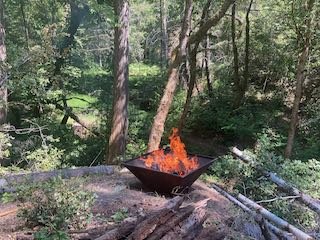
Trapezoidal Kon-Tiki kiln design
Biochar is neither green nor not, but methods make it so
Read moreIntroduction to Biochar
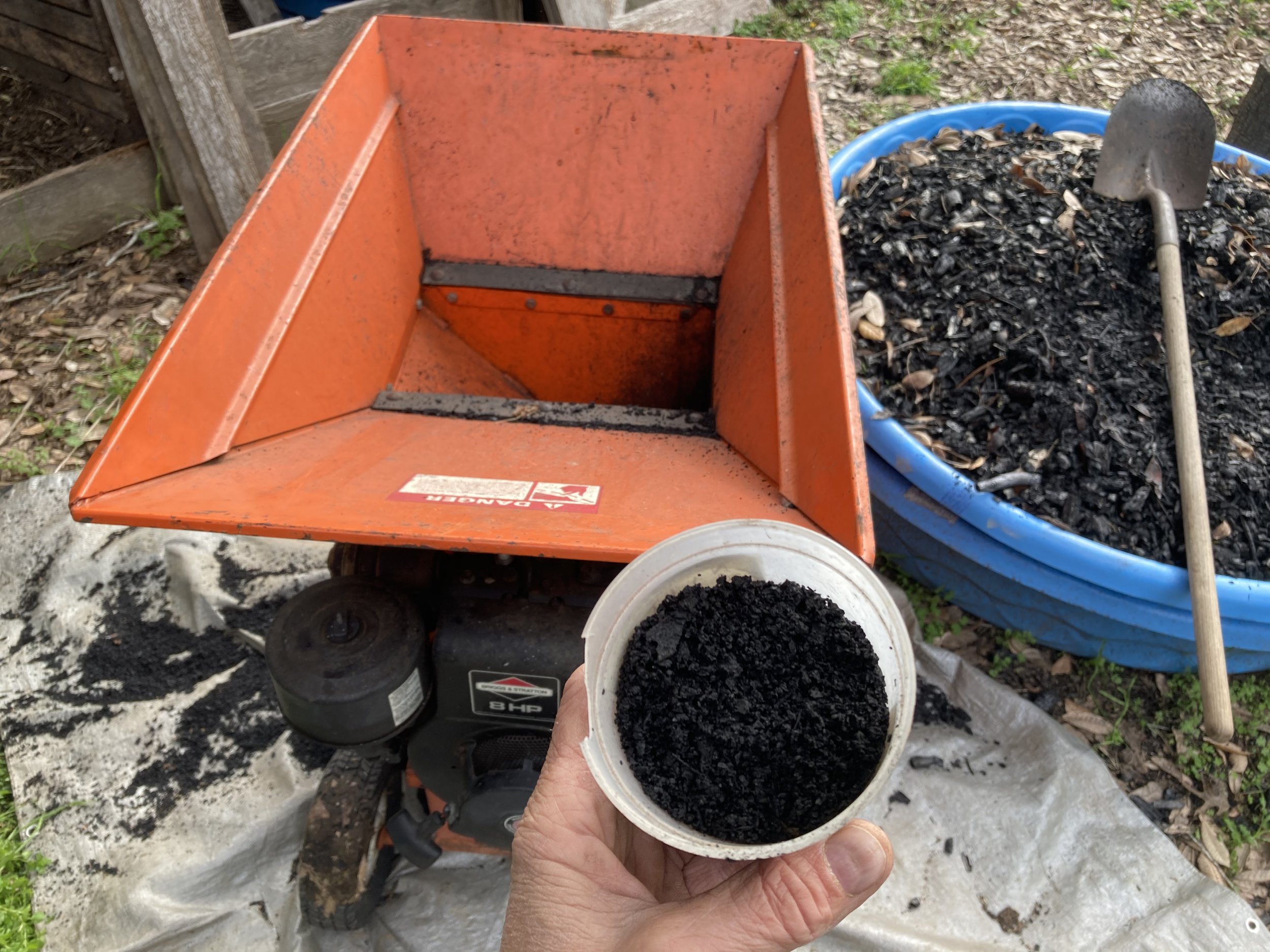
Trying out a garden shredder for grinding char.
Lessons from the Biochar Road Show
Read moreBiochar Basics

Interview of Gray Shaw and Susan Nolan for KMUD’s “Burning Issues” program in March 2020, covering points presented during their “Biochar Road Show”
Read moreDrought Hardening with Biochar

Water retention can buffer droughts caused by climate change
Read moreIndigenous Fire and Lifestyle
This fascinating and wide-ranging interview on Native American landscape practices was produced for the Institute for Sustainable Forestry and aired on KMUD (Redway, CA).
Read moreGirdling Douglas-firs
I wrote and presented a half-hour radio program as part of ISF’s Sustainable Forestry Journalism Project, centered on girdling Douglas-firs for ecological restoration and fire safety.
Read more