Foliar application of highly diluted salicylic acid (SA) can help protect high-value perennial crops like nuts, fruits, and wine grapes from heat, cold, depleted or polluted soils, and many pests. SA is usually synthesized, but it’s a naturally occurring plant hormone from willow tree bark that stimulates plants’ natural defenses against biotic and abiotic stressors. The response is fast-acting and lasting, which is backed up by hundreds of peer-reviewed research papers. SA powder is inexpensive to buy and ship, and is available worldwide.
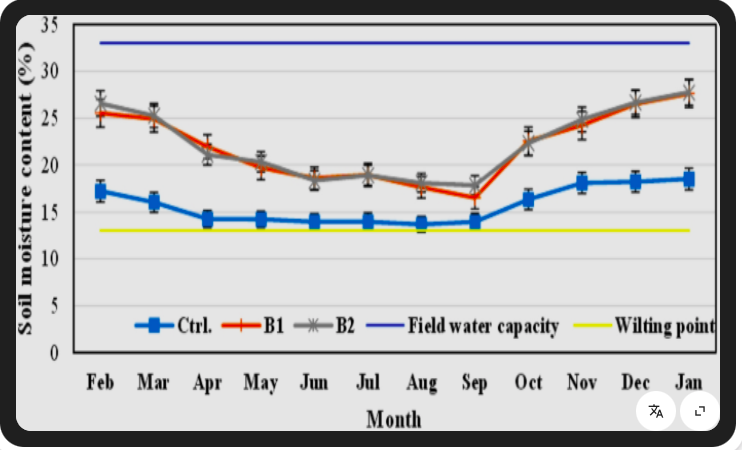
Data from fig study cited below
In the soil, SA works best with biochar. Nearly all of the hundreds of search results that Google Scholar found for “biochar,” "salicylic acid” and "increased yields” were research papers about combining SA with biochar. SA acts synergistically with soil-based biochar to help crops adapt to extended drought, which currently applies to about 40% of the world and is a top concern of farmers and agricultural researchers, needless to say.
For example, in a four-year (2021-2024) trial of rain-fed fig groves in Iran, biochar and SA used together increased yields about 300% with a benefit-to-cost ratio of 13.5, compared to controls that had neither SA nor biochar. Biochar and SA individually increased yields by about 100%, compared with controls.
This spring, Kim Chaffee, a board member of USBI, will be conducting trials in Washington State and in Sweden to compare SA with biochar and separately. Anyone who is interested in conducting their own low-cost and simple trials anywhere in the world should contact him. He will compile the results with photos, aiming toward near-term publication. For more information, see Kim’s blog post in the November 5, 2025 Biochar Today.
Of course, you can just buy some and try it out. You can get 100g for $65 here.
Another promising growth stimulant connected with biochar is pyroligneous acid (PA), a byproduct of pyrolysis. PA is condensed smoke, aka “liquid smoke” (sold as a barbecue flavoring) or wood vinegar, which in addition to being an effective foliar spray can be used to manufacture many other useful compounds. There is very little published research on PA, so Dr. Chaffee is conducting trials to change that.
He is collaborating on this with Norm Baker, Ph.D. in Washington State, who has lots of experience with biochar trials and is currently writing a book on biochar. They plan to use a commercial brand of PA, such as Corigin’s Coriphol or Blue Sky Biochar’s Wood Vinegar in North American-based trials. It’s not as easy to procure PA elsewhere in the world. Production of PA has not been adapted for back yard pyrolysis, to my knowledge, but like SA, at foliar application rates it is inexpensive to buy. Here’s a source for $35/liter. You can find YouTubes of simple systems for making small batches, but I only know of one that integrates production of PA and biochar at scale.
Bob Wells on Cape Cod has developed a semi-industrial scale biochar kiln that co-produces PA. Bob’s kiln, the AR-1, is so efficient at condensing smoke that a city in China purchased one to install within the city limits, where emissions are prohibited. Instead of using the extra heat of pyrolysis to consume all the smoke, as a flame cap kiln does, the AR-1 uses it to fully dry the wood chips used as feedstock, then extracts the remaining heat to condense the smoke, resulting in substantial amounts of PA.
SA is a discrete chemical compound, while PA is a blend of compounds that will vary depending on the biomass used and the process conditions. Thus you will get reproducibility with SA, while with PA there will potentially be very “noisy” results. Even a commercially available PA from the same company will vary in its ingredients over time.