This article is for folks who want a deeper understanding of what makes biochar what it is. I began writing it to help explain why deer eat my biochar, then expanded it here with concepts that apply to any way that biochar is used. You can get along fine just making and using biochar without this knowledge, but if you become interested in what’s under the hood, read on.
Division by heat: The first step in making biochar is pyrolysis. Strictly speaking, wood does not burn; in a fire it separates into two substances, one of which burns right away, releasing heat to keep the division going; the other accumulates, awaiting its turn to burn. The first fuel is a diverse group of volatile emissions, and the other is a homogeneous solid residue. Pyrolysis, aka destructive distillation, is the term for this heat-driven chemical conversion of biomass into its constituent fuels. Pyrolysis is a part of every biomass fire.
Volatiles and the flame cap: The volatile emissions consist of a buoyant mix of gases and particulates called “volatiles.” Flames are simply burning volatiles. The solid residue gradually becomes charcoal as heat drives the volatiles out of it. To illustrate the principles involved, here’s an idealized description of what happens in a biomass fire.
The volatiles more or less envelop the biomass as it pyrolyzes. When they ignite, they form a “flame cap” that uses up oxygen, preventing it from reaching the solid residue—charcoal—until the volatiles are burned off. At that point, the flames go out and air reaches the charcoal, which starts to burn, leaving ash behind. When we see ash start to form on the surface of the charcoal, we extinguish the fire to preserve it.
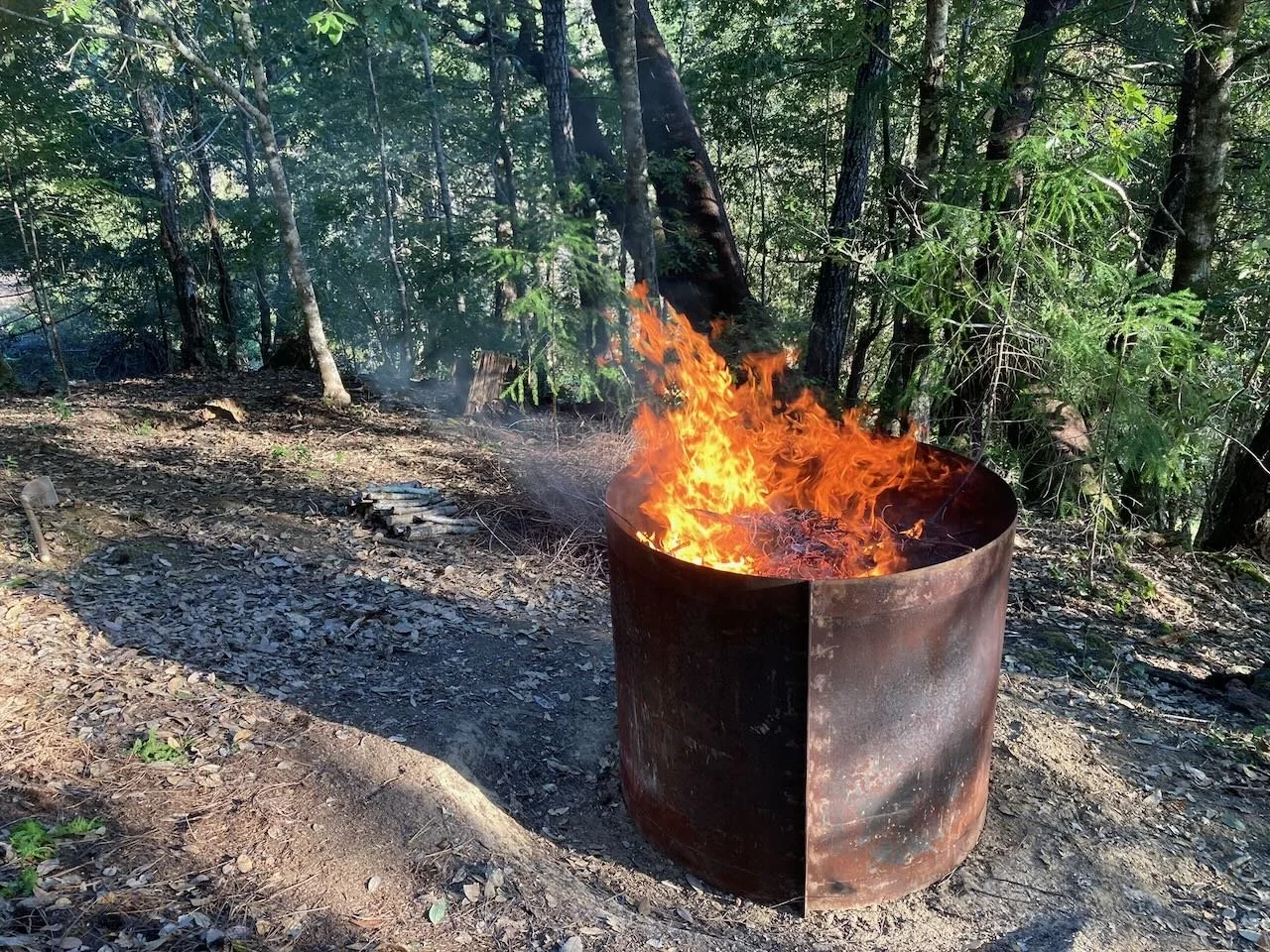
In reality, ordinary biomass fires have a haphazard flame front, so that air reaches parts of it before the volatiles in other parts have finished burning. To make biochar, we control air flow to create an even flame cap that functions as insulation, protecting the charcoal underneath. One way of doing this is to light piles on top, so that the flames intercept the volatiles rising from the biomass. Another is to use a kiln to force air to approach only from the top, which allows us to add more biomass gradually. Then as we add fuel to the fire, the flame cap rises through it and the charcoal builds up underneath in its wake. Volatiles won’t escape unburned as long as we don’t overwhelm the flame cap by adding too much at once. When we stop adding fuel and the flames finally go out, the distillation is complete and pyrolysis is over. At that moment, we extinguish the fire to preserve the charcoal.
Ignition: The heat required for pyrolysis typically comes from burning the volatiles that pyrolysis creates, but it requires heat to begin, so until there is enough heat, there is no fuel. All the biomass in the world will not ignite without an initial external heat source, as any firefighter will tell you. But once the volatiles are burning, their heat keeps generating more volatiles from the biomass. (A closed vessel containing biomass that’s heated externally is known as a retort. Classically, biomass is burned around the vessel to provide that heat.) In nature the ignition source is lightning, but we humans have other ways.
Temperature: For woody biomass, pyrolysis occurs between 300 and 700°C (572–1,292°F). Below that, biomass just dries and roasts. Roasting is technically known as torrefaction. Because torrefaction breaks some chemical bonds in biomass, it’s sometimes called “partial pyrolysis.” At the lower end of this range (300–400°C or 572–752°F), many would-be volatiles are left behind. To make good quality biochar, we aim for up to 700°C to burn off more volatiles, although this also consumes more of the charcoal. There is an inevitable tradeoff of biochar volume for quality as the temperature goes up. Volatiles typically burn at 340°C (644°F), which is more than enough heat to keep pyrolysis going. Charcoal burns at about the same temperature, but its maximum temperature can exceed 1,100°C (2,012°F) with forced air.
Controlling air pollution: In a biomass fire, the volatiles either burn or escape as air pollution. Smoke is just particulates that escaped combustion. To minimize pollution, ideally we want the all volatiles to burn, which we achieve by concentrating heat and controlling air flow—the main benefits of using a flame cap kiln—and by not adding fuel too fast. This also results in more complete conversion (see below), which benefits biochar quality. The same conditions that minimize pollution also maximize the longevity and effectiveness of the biochar.
Flame cap kilns and top-lit piles vastly reduce pollution compared with conventional burn piles lit at the bottom, the way most of us learned to light them. Even if you’re planning to burn brush piles completely, they burn much faster and more thoroughly when lit on top. If we are making biochar to a particular standard, such as for sale, or if pyrolysis is to be done in a location sensitive to small amounts of smoke, then it would be important to invest in more advanced equipment. But the minor imperfections of combustion in piles and low-cost flame cap kilns should be of no concern to homeowners, property managers and forest tenders.
Complete conversion: Pyrolysis always leaves some unburned compounds in the char. This is where flavors come from for grilling or filtering booze. For biochar, the more we can eliminate those other compounds, the better. Hydrogen is one of the elements they contain, which is why testing for H:C ratio determines biochar quality; the lower the better. But as long as we burn correctly to eliminate smoke, the quality we get from kilns and piles is plenty high enough for making biochar to use as a soil amendment, and if we’re making it from excess biomass, we’re usually not concerned with productivity either.
Burning off these compounds can be enhanced in two ways: higher temperature and longer residence time. At higher temperature, more volatiles are expelled from the biomass. Residence time means how long a temperature is sustained; more time leads to more complete conversion.
In an open system, such as a simple pile or a flame cap kiln, there’s not much we can do to increase residence time, because for any given amount of biomass, burning off the volatiles takes a certain amount of time. If we let the fire continue past pyrolysis, air will flood the char and the fire will consume it. But there are ways to increase the temperature. One way is to use a kiln to insulate the fire—especially a double-walled kiln. Higher temps also result from providing forced air, although some charcoal will be lost due to oxygen reaching it while air is being blasted onto the biomass. When you burn hotter, you might make less biochar, but you’ll burn off more of the volatiles. (Retorts, being closed systems, get around this tradeoff.)
Chemical restructuring: There’s more to pyrolytic conversion than just expelling the volatiles. The carbon in the charcoal is restructured into molecular rings, aka aromatic rings for reasons beyond the scope of this article. Biomass is mostly made of linear molecules called polymers. Pyrolysis breaks the bonds that form polymers, freeing the carbon atoms to re-associate into rings, which are nearly impervious to decomposition except by fire. The carbon rings then start attaching to each other in graphene-like sheets that are one molecule thick. Graphene is the name for perfect carbon sheets; biochar consists of a jumble of imperfect carbon sheets that partially align during pyrolysis. How much they align is an aspect of biochar’s quality and durability.
So, chemical restructuring in pyrolysis happens at both atomic and molecular levels. The char might look very similar to the biomass from which it’s made, even under a microscope, but invisible changes have occurred.
The reason we care about this ring structure is twofold. First, it makes the carbon inedible as food. This is what makes biochar last for centuries, preventing carbon from reentering the atmosphere. Secondly, carbon in this form is polarized, so it holds nutrients and immobilizes toxins. Nutrients are held loosely enough to remain available to plants in the soil, while toxins bind tightly and remain attached instead of entering the food chain. (Their affinity for polar molecules is what makes toxins toxic, because they bind to organic molecules like hemoglobin in the same way, blocking essential metabolic functions.) High-temperature pyrolysis actually makes biochar electrically conductive, which directly boosts soil microbial life by accelerating the interspecies electron transfer on which it depends to digest and derive energy from organic matter.
Medicinal activation: When we ingest biochar, toxins are extracted from our gut and carried out of our bodies in our solid waste. This is why deer and other animals eat biochar; instinct has taught them to consume it despite its nearly complete lack of nutrition. The higher the heat of pyrolysis, the greater the biochar’s polar structure and the more it chelates toxins from the body. Animals are able to tell the difference between biochar of different qualities.
Humans have learned to increase this effect with activation. Activated charcoal has been blasted with steam, stripping off residual compounds left behind during pyrolysis to create nearly pure charcoal and increasing its molecular organization and surface area. Activation consumes a high percentage of the charcoal but makes it much more effective at detoxification.
Pyrolysis in nature: When we pyrolyze biomass, it mimics the natural production of charcoal. In a natural fire, a portion of the biomass remains as charcoal, which then serves a dual function as a detoxifier and a soil amendment. In fact, charcoal that passes through an animal ends up serving both of these functions. Toxins, whether they are in the soil or in our bodies, tend to remain attached to the charcoal, sequestered along with the carbon.